
 Home
Home
 About
About 
 Blog
Blog
 Autism strengths
 AuDHD
AuDHD
 Autism tests
 Autism assessments
 Store
Store
 Contact


It’s often hard to recognize co-occurring OCD in autism—let alone knowing what to do to recover from it or treat it. In this article, I go into the challenges of recognizing that you have OCD, and what has helped me reduce my OCD.
The importance of knowing you have OCD
I think the strangest thing for myself about my Obsessive–Compulsive Disorder (OCD) was that I did not know I had OCD. My obsessions and compulsions seemed perfectly reasonable to me despite the suffering they caused me.
Many people with OCD don’t recognize their obsessions and compulsions as unreasonable. This limited insight is sometimes referred to as ego-syntonicity and is common, potentially delaying help-seeking.[1]Insight in Obsessive-Compulsive Disorder: Relationship With Sociodemographic and Clinical Characteristics (Guillén-Font et al., 2021)[2]A study of clinical correlates and predictors of insight in obsessive compulsive disorder (Sinha et al., 2024) Individuals with poor insight often have more severe symptoms and more prolonged illness duration.[3]Obsessive-compulsive disorder with poor insight: a three-year prospective study (Catapano et al., 2010)[4]A study of clinical correlates and predictors of insight in obsessive compulsive disorder (Sinha et al., 2024) For autistic individuals, obsessive patterns tied to moral reasoning or perfectionism can feel internally consistent, like an extension of one’s values rather than a symptom. Given the documented elevation of autistic traits within OCD and the high co-occurrence of OCD and autism, moral or perfectionistic OCD can seem entirely reasonable.[5]Prevalence and Correlates of the Concurrence of Autism Spectrum Disorder and Obsessive Compulsive Disorder in Children and Adolescents: A Systematic Review and Meta-Analysis (Aymerich et al., 2024)[6]Autistic traits in obsessive compulsive disorder: A systematic review and meta-analysis (Derin et al., 2025)
Modern diagnostic systems such as the DSM-5-TR and ICD-11 now classify OCD insight as a spectrum, ranging from good or fair insight (recognizing that beliefs are probably not true) to poor or absent insight (being convinced they are true). In a prospective cohort, approximately 22% of adults with OCD fell into the poor-insight range,.[7]Obsessive-compulsive disorder with poor insight: a three-year prospective study (Catapano et al., 2010) and more recent studies confirm that a significant minority of individuals show impaired insight.[8]Insight in Obsessive-Compulsive Disorder: Relationship With Sociodemographic and Clinical Characteristics (Guillén-Font et al., 2021)[9]A study of clinical correlates and predictors of insight in obsessive compulsive disorder (Sinha et al., 2024) Individuals with poorer insight are less likely to view their obsessions and compulsions as excessive and therefore often delay seeking help until symptoms become debilitating. In a large multicenter clinical study, the median delay to treatment for OCD was about 4 years, with nearly one-third waiting more than 10 years to seek specialized help.[10]Latency to treatment seeking in patients with obsessive-compulsive disorder: Results from a large multicenter clinical sample (Costa et al., 2022)
For myself, it was decades before I recognized it. Many different therapists asked me over and over why I had a persistent need to be good and if I thought it was reasonable—yes I told them, most definitely reasonable. My son at age 14 told me that he thought that I might be too ethical—I wondered what he was up to. Teachers called my parents in to discuss my need to be good and to not break rules—I felt proud. My partner has wept over my self-hatred at any hint of hurting others and watched me sacrifice any needs of mine to avoid anxiety—I felt that I was being different than my parents and that this was good. I never ever saw it as a problem until my current therapist suggested I had moral scrupulosity OCD.
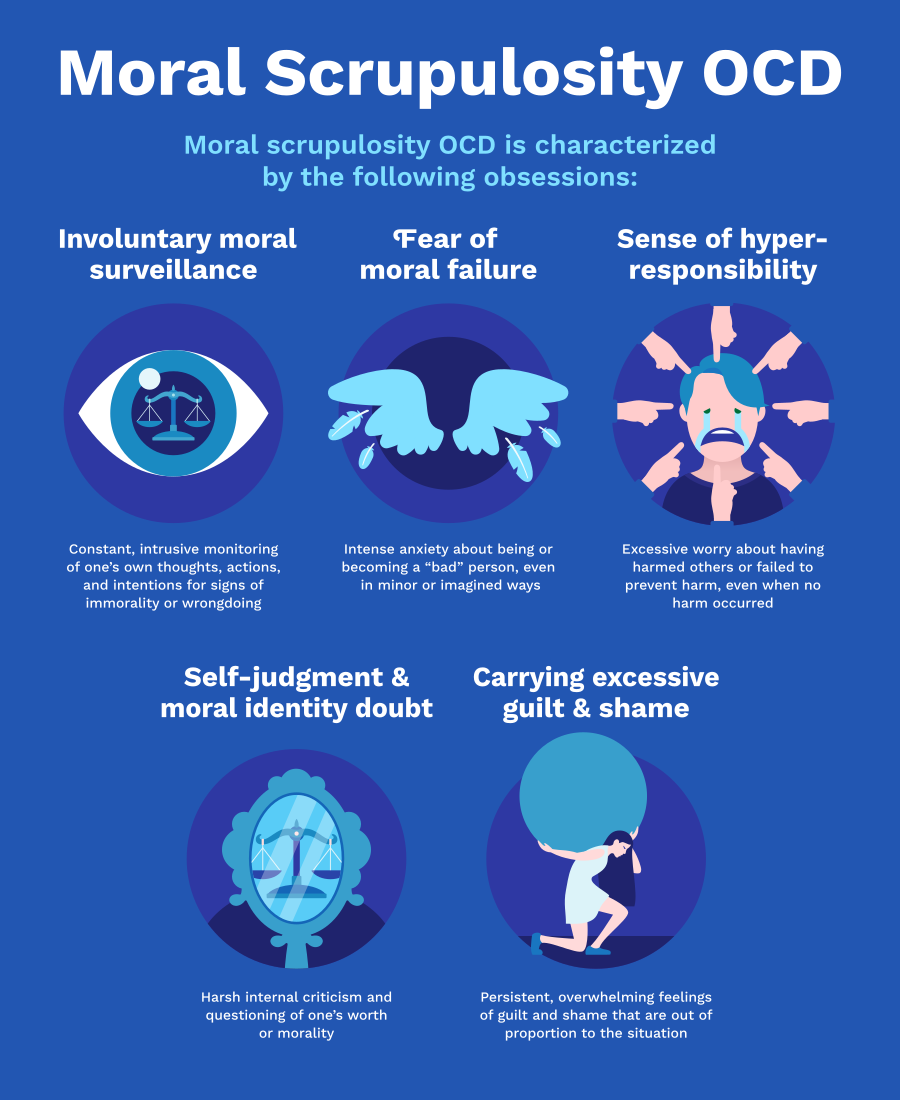
For many autistic people, OCD symptoms are often overlooked or misinterpreted. Clinicians sometimes attribute repetitive thoughts and rituals to “just part of autism,” a phenomenon known as diagnostic overshadowing, which can delay diagnosis and treatment.[11]Prevalence and Correlates of the Concurrence of Autism Spectrum Disorder and Obsessive Compulsive Disorder in Children and Adolescents: A Systematic Review and Meta-Analysis (Aymerich et al., 2024) Knowing you have OCD truly matters because it changes how you understand your experiences and what helps.
One example happened when I was working with patients in preventative medicine. A patient asked me to publish some smoothie recipes on my well-loved blog, which had over 500 articles that people used regularly. Then another patient complained about the smoothie posts. Unable to make both of them happy and feeling like I would hurt one of them, I deleted my entire blog.
That was a regular compulsion: getting rid of things that put me in a position where I couldn’t please someone, and therefore felt like I was hurting them. And like many people with OCD, I didn’t recognize my behaviour as a problem, it simply felt like the “right” thing to do. This lack of insight is common in OCD and often makes self-referral difficult.[12]Autistic traits in obsessive compulsive disorder: A systematic review and meta-analysis (Derin et al., 2025)
My obsessions involved never upsetting anyone, being good, and my compulsions involved giving up my autonomy to ensure that other people were never upset and that I was always good. Publishing my first book was really difficult, as I had anxiety about someone not finding it helpful enough. That would mean I was a bad person.
Early-onset OCD, the type I have, is more prevalent in autism. The early-onset form is more neurodevelopmental in nature, it overlaps with autism and tic disorders, carries a stronger genetic load, and often involves symmetry/checking and moral-perfectionism patterns.[13]Developmental Considerations in Obsessive Compulsive Disorder: Comparing Pediatric and Adult-Onset Cases (Geller et al., 2021) It’s not simply anxiety, it’s a deeply wired need for order, fairness, and predictability. Adult-onset OCD, on the other hand, is more likely to cluster around contamination and harm-related doubt, often emerging after trauma, postpartum changes, or prolonged stress.[14]Obsessive-compulsive disorder (Stein et al., 2019)[15]The epidemiology of obsessive-compulsive disorder in the National Comorbidity Survey Replication (Ruscio et al., 2010)
What has worked best for me
Recognize → Reframe → Refocus → Repeat
I first came across this approach through You Are Not Your Brain by Jeffrey M. Schwartz, MD, and Rebecca Gladding, MD. Their four-step method—recognize, reframe, refocus, repeat, helps retrain attention away from obsessive loops.
When I first read the book, I didn’t practice it. I read about it and even prescribed it. It wasn’t until I took a course on the Dynamic Neural Retraining System (DNRS) out of desperation that I began to tell myself STOP, STOP, STOP when an unpleasant thought arose, then consciously refocus on something else for fifteen minutes. I didn’t know I had OCD at the time, only that I ruminated and that autism was involved. That simple habit of interruption and redirection helped immensely.
Recent studies suggest that cognitive refocusing and Metacognitive Training (MCT) can improve obsessive thinking by helping people reinterpret intrusive thoughts as noise rather than truth.[16]You are not your brain: The 4-step solution for changing bad habits, ending unhealthy thinking, and taking control of your life (Schwartz & Gladding, 2011) For autistic individuals, structured, repetitive self-talk and visual reminders can make this even more effective.[17]Prevalence and correlates of the concurrence of autism spectrum disorder and obsessive-compulsive disorder in children and adolescents: A systematic review and meta-analysis (Aymerich et al., 2024)
Breathing
My three favourite techniques are:
- 6-2-4-2 breathing, a paced-breathing pattern that supports autonomic balance.
- Buteyko breathing, which uses gentle nasal breathing and short breath holds to normalize carbon dioxide (CO₂) levels and reduce hyperventilation.
- A52 breathing, which involves a five-second inhale, five-second exhale, and a two-second post-exhalation hold, creating roughly five breaths per minute. The method emphasizes nasal breathing (especially on the inhale) and a gentle pause after each exhalation.
Breathing exercises are increasingly recognized as powerful tools for regulating anxiety and OCD. Slow, nasal, diaphragmatic breathing activates the parasympathetic nervous system and can lower cortisol, heart rate, and obsessive rumination.[18]How Breath-Control Can Change Your Life: A Systematic Review on Psycho-Physiological Correlates of Slow Breathing (Zaccaro et al., 2018) All three techniques help shift my body out of fight-or-flight and into a calmer, more grounded state. I’ve learned that the way I breathe can dramatically influence how I think and feel. When my breath slows, my heart rate and thoughts slow too.
Research backs this up. Across multiple studies, slow nasal diaphragmatic breathing has been shown to strengthen the body’s natural calming system. It improves vagal tone and heart rate variability (HRV)—that tiny rhythm between heartbeats that tells the nervous system it’s safe to rest.[19]How Breath-Control Can Change Your Life: A Systematic Review on Psycho-Physiological Correlates of Slow Breathing (Zaccaro et al., 2018) The brief pause after each exhale, that two-second stillness in the A52 method, also plays an important role. It gently increases carbon dioxide levels and activates chemoreceptors that send the body a message of safety and ease.
Psychologically, these same breathing rhythms have been linked to lower cortisol, reduced anxiety, and fewer obsessive or stress-driven thoughts. Participants in the studies described feeling clearer, more balanced, and more emotionally steady as their bodies moved out of constant alert mode.[20]How Breath-Control Can Change Your Life: A Systematic Review on Psycho-Physiological Correlates of Slow Breathing (Zaccaro et al., 2018)[21]The A52 Breath Method: A Narrative Review of Breathwork for Mental Health and Stress Resilience (Little, 2025)
Nearly two-thirds of known breath practices use this same slow, rhythmic pace. Little’s review brought them together under one simple, evidence-based framework—the A52 breath method—to make breathwork research more accessible and practice more consistent.[22]The A52 Breath Method: A Narrative Review of Breathwork for Mental Health and Stress Resilience (Little, 2025)
For me, these studies simply affirm what I’ve already felt in my own body. When the breath becomes steady, the mind begins to trust that it’s safe. One slow exhale at a time, the body learns what calm feels like—and eventually, it remembers how to return there on its own.
Compassion-based therapy
I’ve been fortunate to find a therapist who helps me approach my inner world with gentleness and curiosity. Our work isn’t about dissecting trauma or reliving the past; it’s about learning to meet my thoughts and feelings with compassion instead of criticism. His approach is deeply humanistic, blending questions for me to answer, presence, breathing, and self-kindness in a way that feels healing.
Recent research reflects this shift toward compassion as a foundation for emotional well-being. A large mixed-method study by Cai et al. explored self-compassion in autistic and non-autistic adults and found that, while autistic participants tended to report lower self-compassion overall, those who cultivated it experienced clear benefits—less anxiety and depression, and greater psychological well-being.[23]“Self-compassion changed my life”: The self-compassion experiences of autistic and non-autistic adults and its relationship with mental health and psychological wellbeing (Cai et al., 2023) Many described self-compassion as life-changing: it helped them move from relentless self-criticism to a kinder, more forgiving way of being.
Building on this, a qualitative study of an autism-specific self-compassion program, the Aspect Self-Compassion Program for Autistic Adults (ASPAA), found similar patterns.[24]A qualitative exploration of an autism-specific self-compassion program: The ASPAA (Edwards et al., 2024) Participants spoke about learning, often for the first time, to extend to themselves the same patience and care they gave to others. Some found it uncomfortable at first, as if self-kindness felt undeserved, but over time it became a practice they could return to when guilt or anxiety arose. What helped most, they said, was that the program was created for autistic adults, it offered clear structure, gentle pacing, sensory-friendly options, and lived-experience examples that made the process feel safe and relatable.
Learning to offer myself compassion has changed my relationship with myself. The first change I noticed was that I began to believe the people closest to me really did love me. I also started to soften toward my younger self, to see her mistakes not as proof of failure, but as part of being human. Like the participants in these studies, I’ve learned that compassion isn’t a destination. It’s a practice, a way of relating to myself, one kind thought, one forgiving breath at a time.
Mindfulness
I’ve practiced mindfulness since I was eighteen. I use a Concentration–Insight method (or Vipassanā meditation in Buddhism), which helps me sit with uncomfortable sensations and stay present with whatever arises. At first, mindfulness was simply a way to survive the intensity of my thoughts. Over time, it became something deeper, a way to truly be happy.
Recent research shows that mindfulness can be a valuable therapeutic tool for obsessive–compulsive disorder. A 2024 review by Reis et al. found that mindfulness-based interventions can reduce obsessive rumination and distress by strengthening emotional regulation, acceptance, and cognitive flexibility, skills that help people observe intrusive thoughts without automatically reacting to them.[25]Mindfulness as a therapeutic option for obsessive-compulsive disorder (Reis et al., 2024) Mindfulness doesn’t eliminate the thoughts themselves; it changes our relationship to them, allowing space between impulse and action.
For autistic individuals, mindfulness is gaining recognition as a useful practice for managing stress, sensory overload, and emotional regulation. In a 2024 feasibility study, Agius et al. explored a Mindfulness-Based Stress Reduction (MBSR) program for autistic adults in outpatient care.[26]Mindfulness-based stress reduction for autistic adults: A feasibility study in an outpatient context (Agius et al., 2024) With thoughtful adaptations, smaller groups, clear structure, plain language, and low-sensory settings, participants not only stayed engaged (nearly 80% completed the course) but also reported reduced stress, anxiety, and depression after eight weeks. Many described feeling calmer, more self-aware, and better able to navigate daily challenges, even if their “mindfulness scores” didn’t always change. It suggested that the body often learns safety before the mind recognizes it.
A broader 2024 systematic review by Simione et al. examined 37 mindfulness-based studies involving autistic people and their caregivers. Across the studies, participants showed improvements in psychological well-being, emotional balance, and behavioral regulation.[27]Mindfulness-Based Interventions for People with Autism Spectrum Disorder: A Systematic Literature Review (Simione, 2024) Mindfulness was linked to reductions in distress and reactivity, as well as greater cognitive control and social engagement. Although the authors cautioned that many studies were small or methodologically varied, the overall evidence points to mindfulness as a promising support for autistic adults, especially when adapted to different sensory and communication needs.
In my own life, mindfulness has taught me that peace doesn’t come from silencing my thoughts, but from being present and curious about them.
Medication
For many of us with OCD, the turning point doesn’t come from willpower or therapy alone, but from finding the right balance between biology and psychology. As I learned through experience, medication can quiet the constant noise just enough for everything else, therapy, mindfulness, and self-compassion—to finally take root.
The International College of Obsessive-Compulsive Spectrum Disorders (ICOCS) published a landmark position paper summarizing the last decade of OCD research.[28]Clinical advances in obsessive-compulsive disorder: A position statement by the International College of Obsessive-Compulsive Spectrum Disorders (Fineberg et al., 2020) It reframed OCD not as a failure of self-control but as a neurodevelopmental condition involving specific brain circuits, particularly those linking the orbitofrontal cortex, striatum, and thalamus. In OCD, these circuits tend to run on overdrive, creating loops of over-checking, moral overresponsibility, and emotional alarm that don’t easily switch off.
Medications that modulate serotonin remain the most effective way to calm this circuitry. The ICOCS consensus reaffirmed that SSRIs—fluoxetine, sertraline, fluvoxamine, paroxetine, and escitalopram—are still the first-line treatment, though higher doses than those used for depression are often needed. Clomipramine, one of the earliest serotonin-targeting medications, remains a strong alternative, especially for individuals who don’t respond to SSRIs.
When OCD proves resistant, other medications can help fine-tune the system. Low-dose antipsychotic augmentation where a secondary antipsychotic is given (commonly risperidone, aripiprazole, or quetiapine) when the primary antipsychotic or SSRI shows low efficience can enhance SSRI response—particularly for those with intrusive thoughts, tics, or co-occurring autism. Researchers are also exploring glutamate-modulating agents, which may help rebalance the overactive neural feedback loops that maintain compulsive behaviour.[29]Glutamate-Modulating Drugs as a Potential Therapeutic Strategy in Obsessive-Compulsive Disorder (Marinova, Chuang, & Fineberg, 2017)
A recent narrative review by Ong and Chee (2024) examined pharmacological management of obsessive–compulsive behaviours in autistic youth, providing insights that extend to adults as well.[30]Psychopharmacological management of obsessive–compulsive behaviour in children and adolescents with autism spectrum disorders: A narrative review (Ong, 2024) They found that while SSRIs remain the most studied and frequently prescribed, responses vary widely: some individuals improve, while others experience little change or heightened anxiety. In select cases, atypical antipsychotics like risperidone and aripiprazole showed benefit when repetitive behaviours were distressing or disruptive. The authors emphasize that treatment should be individualized, recognizing that not all repetitive behaviours in autism are pathological, and that medication should target distress, not difference.
These advances mark a shift away from the old “chemical imbalance” model toward a neural rhythm model, one focused on restoring regulation rather than suppression. Medication, in this view, is used to bring the nervous system back within a window of tolerance, where therapy and self-understanding can finally work. As Fineberg and colleagues note, the most effective treatment often comes from combining biological support with psychological flexibility.
I experienced this firsthand. After years of trying to manage my symptoms through insight and mindfulness alone, I found significant relief after adding just a quarter of a 25 mg tablet of quetiapine (Seroquel). The change was subtle but profound: my mind felt quieter, my anxiety less intrusive, and my body more at ease. My sleep improved noticeably, in both quality and consistency.
Quetiapine works on several neurotransmitter systems—serotonin, dopamine, histamine, and norepinephrine, creating a broad, calming effect at low doses. Interestingly, it is also a potent antihistamine, which may explain why my seasonal “ragweed depression” lifted soon after starting it. When I later underwent an allergy skin test, the procedure had to be repeated because I showed no reaction, even to the control.[31]Does treatment with antidepressants, antipsychotics, or benzodiazepines hamper allergy skin testing? (Kjaer et al., 2021)
At these low doses, quetiapine primarily affects serotonin and histamine receptors, producing sleep-restoring and anxiolytic effects without strong dopamine blockade.[32]Clinical advances in obsessive-compulsive disorder: a position statement by the International College of Obsessive-Compulsive Spectrum Disorders (Fineberg et al., 2020) For me, this small dose reduced obsessive looping, improved sleep, and softened emotional volatility without dulling my mind. It felt as if my nervous system finally had permission to rest.
Recognizing co-occurring OCD in autism
Autism and OCD often intertwine in ways that even experienced clinicians can miss. Repetitive behaviours, moral rigidity, or intense focus may look like autism when they’re driven by obsession, or like OCD when they’re actually self-regulatory or sensory in nature. The difference matters, not because one label is better than another, but because understanding why a behaviour happens informs how we can help. Treatment that overlooks this distinction can unintentionally pathologize autistic coping or leave obsessive distress untreated.
It’s important to work with clinicians who are trained to recognize the subtle overlap between autism and OCD. At Embrace Autism, our assessments are designed for exactly this purpose. We use current DSM-5-TR criteria interpreted through 2025 research, and we evaluate for co-occurring conditions such as OCD, ADHD, anxiety, and trauma. Every assessment is conducted by psychologists and clinicians who are autistic themselves, combining scientific precision with lived empathy.
Here is a page where you can find information about
our assessment process and our diagnostic team:





Comments
Let us know what you think!