
 Home
Home
 About
About 
 Blog
Blog
 Autism strengths
 AuDHD
AuDHD
 Autism tests
 Autism assessments
 Store
Store
 Contact

You walk into the room and slide into character without thinking. Your smile is practiced. Your laugh lands at the right time. Your posture, tone, and even pauses are all intentional.
By the time you leave, you are grumpy, but holding it in. And once you get home, you go into your room and lie on the bed—not answering the phone, scrolling the Internet mindlessly. You are exhausted.
If you’ve ever walked away from a gathering feeling you’d “played a role” rather than participated as yourself, you may have caught a glimpse of your own mask in the mirror.
This conscious attention to how you interact in order to be accepted is known as masking. It involves blending in, smoothing edges, hiding instincts, doing things you really don’t want to and sometimes a full acting job. It is no wonder so many autistics are real-life actors.
For most of us, it’s a daily performance. And while it can make life seem easier on the outside, inside it can leave you burned out, depressed, anxious and even suicidal.
What masking really is
Masking—also referred to as camouflaging or social camouflaging—is a complex strategy in which autistic individuals suppress natural behaviours and adopt neurotypical social traits. This can include imitating others’ gestures or tone, forcing eye contact, scripting conversations, and stifling stimming or sensory responses.[1]Development and validation of the camouflaging autistic traits questionnaire (CAT-Q) (Hull et al., 2017)[2]Good social skills despite poor theory of mind: Exploring compensation in autism spectrum disorder (Livingston et al., 2019) It can even include just going out to events you would rather stay home and miss due to the emotional and physical cost. You can read more about camouflaging and its three sub-categories here:
Autism & camouflaging
Here is an example of camouflaging and its consequences from my own life: a friend gave me, my partner, and my son tickets to the show they had created the music for. Because it is a close friend, I made the effort to go. We all did. I ended up having a meltdown, and the other two ended up taking anti-anxiety medication to cope. What would have been a fun event for a non-autistic person was a lot for us. The day was too hot, the seats too close, too hard, the actors too loud. No one else there was having any problems. One of my Loop earplugs was lost, so I had to block one ear by pressing my ear closed, and I have a Loop earplug that hurts my ear canal in the other. Traffic turned a 1-hour drive into over 2 hours each way. When I called my friend to say thank you and tell them how much I liked the play and the performance, I didn’t express any of my overwhelm. I will have to do this all again next year.
Sometimes, we don’t notice that we are masking until we have the crash of exhaustion. Other times, our mask is calculated: a rehearsed smile, an internal script, careful control of tone and posture.[3]Development and validation of the camouflaging autistic traits questionnaire (CAT-Q) (Hull et al., 2017)[4]Camouflaging in autism: A systematic review (Cook et al., 2021) It’s constant vigilance: monitoring yourself and others, suppressing instincts, maintaining a look of ease that demands constant upkeep.[5]Development and validation of the camouflaging autistic traits questionnaire (CAT-Q) (Hull et al., 2017)[6]A conceptual analysis of autistic masking: Understanding the narrative of stigma and the illusion of choice (Pearson & Rose, 2021)
Peer-reviewed studies show that while masking smooths social navigation, it comes at a real cost. A systematic review found social camouflaging linked to increased anxiety, depression, identity erosion, and challenges in mental health across ages and contexts.[7]Psychosocial factors associated with camouflaging in autistic people and its relationship with mental health and well-being: A mixed methods systematic review (Zhuang et al., 2023)[8]Social camouflaging in autism: A mixed-method systematic review and meta-analysis (Khudiakova et al., 2024) One qualitative study captured lived experience starkly: adults described masking as exhaustion, self-disconnection, and in many cases, suicidal thoughts.[9]“I have to constantly be aware of who I’m talking to”: Autistic adults’ experiences of camouflaging and its consequences (>Miller et al., 2021)
Autistic women frequently mask more than men, often mirroring social norms so convincingly that diagnoses are delayed or missed entirely.[10]Development and validation of the camouflaging autistic traits questionnaire (CAT-Q) (Hull et al., 2017)[11]Gender differences in self-reported camouflaging in autistic and non-autistic adults (Hull et al., 2020) And while some masking behaviours resemble those in other groups (like non-autistic people or those with ADHD), the suppression of sensory responses and stimming is unique to autistic masking.[12]“I have to constantly be aware of who I’m talking to”: Autistic adults’ experiences of camouflaging and its consequences (Miller et al., 2021)
Why people mask—and what’s at stake
Many autistic adults learn, often without realizing, to hide their differences out of sight. They watch, copy, and edit themselves until the person others see is only part of who they are. Three things stand out in the research.
First, masking is a response to stigma and the need to stay safe. The cost of being visibly different is misunderstanding or exclusion, and so people hide their differences. In one study of over 200 autistic adults, the more stigma participants perceived, the more they camouflaged their traits—especially in professional and public spaces.[13]Understanding camouflaging as a response to autism‑related stigma: A Social Identity Theory approach (Perry et al., 2022)
Even in childhood many of us were already learning to hide in plain sight to blend in.[14]Understanding stigma in autism: A narrative review and theoretical model (Turnock et al., 2022) This of course results in the phrase that people often say to us—“You don’t seem autistic at all.”
Second, masking takes a serious toll on mental health. A 2024 mixed-method review found camouflaging strongly linked to anxiety, depression, and lower overall well-being.[15]Social camouflaging in autism: A mixed-method systematic review and meta-analysis (Khudiakova et al., 2024) Another large-scale study confirmed that those who masked more reported a lower psychological quality of life, no matter how “successful” they appeared on the outside.[16]Camouflaging in autism: Age effects and cross-cultural validation of the camouflaging autistic traits questionnaire (CAT-Q) (Remnélius & Bölte, 2024)
Third, masking can carry life-and-death consequences. Research with autistic university students revealed that higher camouflaging was directly associated with suicidal thoughts and behaviours.[17]Is camouflaging autistic traits associated with suicidal thoughts and behaviours? Expanding the interpersonal psychological theory of suicide in an undergraduate student sample (Cassidy et al., 2020) Broader reviews describe masking as a persistent, cross-diagnostic risk factor for suicidality across the lifespan.
Signatures of masking people might relate to
Masking can be invisible to others, and you might notice it only in hindsight.
A good friend thought he did not mask much at all until he took the CAT-Q. His score was really really high. You can read about his experience and more about the test here: The Camouflaging Autistic Traits Questionnaire
Take the test here:
Things you might recognize yourself doing:
- Rehearse and script what you’ll say before a conversation, or replay it afterward to check how you came across.[18]Gender differences in self-reported camouflaging in autistic and non-autistic adults (Hull et al., 2020)
- Mimic expressions, gestures, or speech rhythms you’ve seen in others, even when they don’t feel entirely your own.[19]Camouflaging in autism: A systematic review (Cook et al., 2021)
- Suppress stims, sensory reactions, or natural movement in public spaces to appear “composed”.[20]“I have to constantly be aware of who I’m talking to”: Autistic adults’ experiences of camouflaging and its consequences (Miller et al., 2021)
- Code-switch between settings—presenting a different version of yourself at work, with friends, and at home.[21]A conceptual analysis of autistic masking: Understanding the narrative of stigma and the illusion of choice (Pearson & Rose, 2021)
- Feel emotionally distant or numb during social interactions, because so much of your energy is directed toward “getting it right”.[22]Understanding the reasons, contexts and costs of camouflaging for autistic adults (Cage & Troxell-Whitman, 2019)
Research consistently shows that these behaviours are not random—they cluster into identifiable patterns of compensation (actively trying to improve social communication skills), masking (hiding autistic characteristics), and assimilation (blending into the social environment).[23]Gender differences in self-reported camouflaging in autistic and non-autistic adults (Hull et al., 2020)[24]Good social skills despite poor theory of mind: Exploring compensation in autism spectrum disorder (Livingston et al., 2019) While they can help navigate challenging environments, each demands sustained cognitive effort, which over time leads to the exhaustion and burnout many autistic adults describe.
Masking and assimilation are the most detrimental for your mental health. If you score above 40, that is significant. And above 45, you are likely to have mental health consequences from these behaviours.
Risks of staying masked too long
The brain can’t sustain this performance forever. Over time, this depletion can become autistic burnout: an intense state of physical, cognitive, and emotional exhaustion that often disrupts daily functioning. You can measure how deeply you have been affected here: The Autistic Burnout Construct
Take the test here:
Among autistic women, high levels of masking have been linked to identity confusion, depressive symptoms, and delayed diagnosis.[25]Gender differences in self-reported camouflaging in autistic and non-autistic adults (Hull et al., 2020) Because their camouflaging can be so effective, many women report that their needs are overlooked or misunderstood for years, leaving them unsupported during key life stages.[26]Good social skills despite poor theory of mind: Exploring compensation in autism spectrum disorder (Livingston et al., 2019)
The risks extend beyond mental health. Camouflaging has been identified as a transdiagnostic risk factor for suicidality—meaning it predicts suicidal thoughts and behaviours across diagnostic boundaries. Cassidy et al. found that autistic adults who engaged in more frequent camouflaging reported significantly higher rates of suicidal ideation.[27]Is camouflaging autistic traits associated with suicidal thoughts and behaviours? Expanding the interpersonal psychological theory of suicide in an undergraduate student sample (Cassidy et al., 2020) These findings have been replicated across age groups, with qualitative accounts describing masking as “erasing” the self until life feels unlivable.[28]“I have to constantly be aware of who I’m talking to”: Autistic adults’ experiences of camouflaging and its consequences (Miller et al., 2021)
Many autistics I have spoken to identify with having suicidal ideation from very young. Often our first burnout comes around grade one or two.
When you’ve spent years pretending to be someone else, finding your way back to yourself is an act of courage and survival.
Questions to ask yourself
Some questions to ask yourself about whether you mask and its adverse effects include:
- Do you find yourself slipping into rehearsed lines?
- Do you feel the muscles in your face relax when you’re finally alone?
- Do you watch parts of yourself drift further away after a long day of socializing?
These moments are worth holding onto—not to judge yourself, but to understand. You might try journaling when you feel most drained, or jotting down how you feel after “performing” versus when you’re just existing in your own rhythm. Over time, patterns can emerge—clues to when the mask is on, and what the costs are.
You can also measure whether and how much you camouflage/mask using the Camouflaging Autistic Traits Questionnaire (CAT-Q). Developed from autistic lived experiences, the CAT-Q is a validated self-report measure that identifies three dimensions of camouflaging—compensation, masking, and assimilation.[29]Gender differences in self-reported camouflaging in autistic and non-autistic adults (Hull et al., 2020) More recently, cross-cultural work has refined and confirmed its reliability in diverse adult populations.[30]A meta-analytic review of quantification methods for camouflaging behaviors in autistic and neurotypical individuals (Cancino-Barros et al., 2025) It’s not diagnostic, and it can’t replace professional assessment, but it can spark meaningful self-awareness—sometimes enough to begin the journey back to your unmasked self.
But everyone masks…
This is simply not true.
When autistic and non-autistic people “mask” at a party, the goal might look similar—fitting in and managing social impressions—but the underlying processes, effort level, and after-effects are usually quite different. Consider these aspects:
Purpose of masking
- Autistic masking is often a learned survival strategy to avoid negative judgments, exclusion, or misunderstandings. It may involve copying speech rhythms, facial expressions, gestures, and topics of interest in real time. The aim is often safety and acceptance rather than social gain.
- Non-autistic masking is more often about impression management—choosing to present a certain image (e.g., more confident, more enthusiastic) to make a good impression, network, or be liked, without necessarily overriding one’s natural style completely.
Cognitive load & consciousness
- Autistic masking usually requires sustained, conscious monitoring of social signals, internal scripting, and suppressing natural behaviors (like stimming or avoiding eye contact). This can mean mentally running a “social checklist” throughout the event.
- Non-autistic masking tends to be more automatic and fluid, guided by implicit social rules absorbed over a lifetime. Adjustments happen subconsciously, freeing up cognitive resources for conversation.
Sensory & emotional regulation
- Autistic masking often involves simultaneous sensory management—blocking out overwhelming sounds, lights, smells—while still tracking social cues. Emotional regulation can require extra energy, especially if authentic reactions differ from expected ones.
- Non-autistic masking usually doesn’t involve active sensory suppression. If discomfort arises, it’s more likely to be emotional or situational rather than multi-sensory.
After-effects
- Autistic masking can lead to “social hangovers,” exhaustion, shutdown, or burnout—sometimes lasting hours to days—because it demands constant self-monitoring and suppression.
- Non-autistic masking may be tiring but is less likely to cause full depletion; recovery might just mean relaxing alone for a short time.
Adaptability over time
- Autistic masking may be harder to maintain if the event runs long or becomes unpredictable; scripts can run out, and sensory overload can increase.
- Non-autistic masking tends to remain stable across different settings because it draws on flexible, practiced social habits rather than memorized strategies.
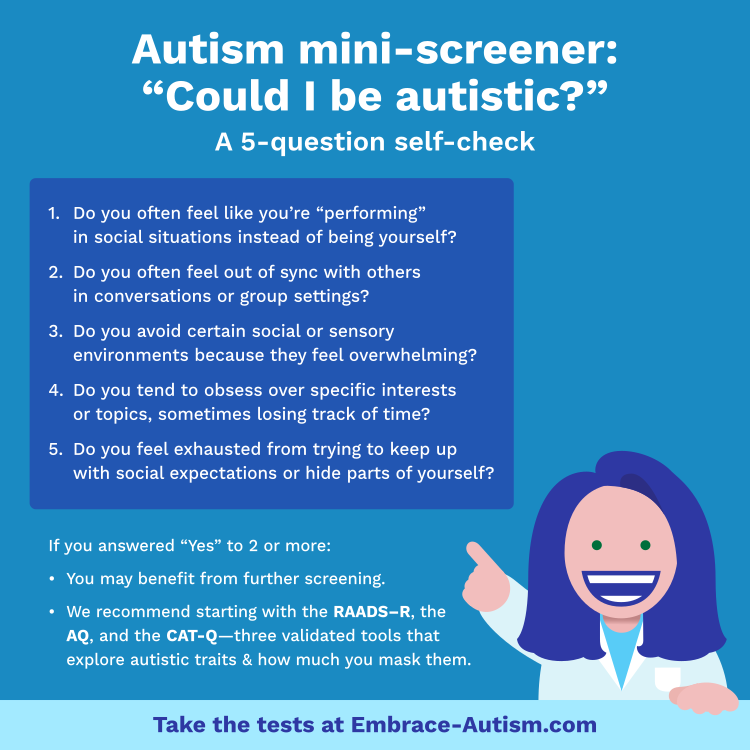
And obviously if you do not know if you are autistic or not, then you do not know which type of masking you are engaging in, and how sustainable it is. Here is a mini-screener to help you know where to start.
Recognizing your mask means you’ve started tuning in to who you are beneath the performance, noticing the moments when you’ve been bending yourself to fit the room instead of letting the room meet you as you are. That awareness is the first step toward relief, toward connection, toward reclaiming the parts of yourself that have been waiting quietly in the wings.
In a culture that rewards fitting in, choosing to honour your differences is a radical act of self-care. Each time you allow yourself to stim openly, speak at your own pace, or let your expression be exactly what it is, you make space for authenticity—not just for yourself, but for every autistic person still wondering if it’s safe to be seen.
Recommended next steps
After the AQ, consider taking one of the tests below.
RAADS–R
Identifies adults who often “escape diagnosis”
due to a subclinical level presentation
Autism Spectrum Quotient
A simple screening test that is used as a basis
for pursuing a formal autism evaluation
CAT-Q
Measures camouflaging, and can account
for lower scores on other autism tests




Comments
Let us know what you think!