
 Home
Home
 About
About 
 Blog
Blog
 Autism strengths
 AuDHD
AuDHD
 Autism tests
 Autism assessments
 Store
Store
 Contact


The Perth Alexithymia Questionnaire (PAQ) is a 24-item self-report measure of alexithymia. The PAQ is designed to assess all three components of alexithymia across negative and positive emotions.
Basic information |
|
|---|---|
| Statements: | 24 |
| Duration: | 5–15 minutes |
| Type: | screening tool |
| Authors: | David Preece, Rodrigo Becerra, Ken Robinson, Justine Dandy, & Alfred Allan |
| Publishing year: | 2018 |
| Seminal paper: | The psychometric assessment of alexithymia: Development and validation of the Perth Alexithymia Questionnaire (Preece et al., 2018) |
Take the test here:
Who the test is designed for
The PAQ is intended to measure the degree of alexithymia in adults and adolescents. An IQ in the normal range (IQ> = 80) is a prerequisite for taking this test.
What is alexithymia?
Alexithymia is a set of traits comprising people’s inability to focus attention on and accurately appraise (i.e., identifying and describing) their own emotions:[1]The psychometric assessment of alexithymia: Development and validation of the Perth Alexithymia Questionnaire (Preece et al., 2018)
People with high alexithymia experience emotions only as undifferentiated pleasant or unpleasant states (e.g., “I am feeling bad” or “I am feeling good”), whereas people with low alexithymia experience emotions in a more nuanced and differentiated manner (e.g., “I am feeling angry, not sad” or “I am feeling excited, not amused”
Although some conceptions of alexithymia (also known as emotional blindness) consist of seven factors (read Eva’s article, the Alexithymia & autism guide to learn more about that), the simplified model consists of three components:
- Difficulty in identifying feelings (both positive and negative)
- Difficulty describing feelings (both positive and negative)
- The tendency to not focus on emotions
Alexithymia is of considerable clinical interest due to its role as a risk factor for several mental illnesses, including depression, anxiety, psychosomatic substance abuse, eating disorders, and personality disorders. Some psychotherapy approaches, like psychoanalysis, can also be negatively affected by alexithymia.[2]The psychometric assessment of alexithymia: Development and validation of the Perth Alexithymia Questionnaire (Preece et al., 2018)
The evidence suggests that alexithymia is a relatively stable trait. As a result of increased distress or targeted treatment, levels of alexithymia can fluctuate over time.[3]An evaluation of the absolute and relative stability of alexithymia in patients with major depression (Luminet, Bagby, & Taylor, 2001)
Versions & translations
The PAQ has been translated into several other languages. These include the following:
- Afrikaans
- Dutch
- Finnish
- French
- German
- Italian
- Persian (2020)
- Persian Fari (2023)
- Polish
- Russian
- Spanish
- Turkish
There is also the Perth Alexithymia Questionnaire-Short Form (PAQ-S), which is a 6-item version
Taking the test
The PAQ consists of 24 statements, giving you 7 choices for each statement ranging from:
- Strongly disagree (1 point), to Strongly agree (7 points)
- Neither agree nor disagree (4 points)
The PAQ comprises 24 statements, broken down into five categories:
- 4 statements on Negative-Difficulty identifying feelings (N-DIF)
- 4 statements on Positive-Difficulty identifying feelings (P-DIF)
- 4 statements on Negative-Difficulty describing feelings (N-DDF)
- 4 statements on Positive-Difficulty describing feelings (P-DDF)
- 8 statements on General-Externally orientated thinking (G-EOT)
Scoring
- Five subscale scores and six composite scores can be derived, with higher scores indicating higher levels of alexithymia.
- Scoring range: 24–168
- Threshold score: 113
What your score means
- 118+ = High level of alexithymia
- 47–117 = Average level of alexithymia
- 46 or less = Low level of alexithymia
It is essential to look at the total score and the first four subscales. If a person has low alexithymia for positive emotions and high for negative emotions, the scores will average each other out.
Have a look at the table below to view the scores consistent with low, average, and high alexithymia.[4]Perth Alexithymia Questionnaire (PAQ): Copy of questionnaire and scoring instructions (Preece et al., 2018) Note that all values have been rounded for the sake of simplicity, so there will be some inconsistencies between the subscale scores added up and the total scale scores. For the scores with two decimals, have a look at the authors’ table on page 5 of their scoring instructions document.
| Subscale | Meaning | Low alexithymia | Average alexithymia | High alexithymia |
|---|---|---|---|---|
| N-DIF | Difficulty identifying negative feelings | ≤7 | 13 | 19+ |
| P-DIF | Difficulty identifying positive feelings | ≤6 | 11 | 17+ |
| N-DDF | Difficulty describing negative feelings | ≤8 | 15 | 22+ |
| P-DDF | Difficulty describing positive feelings | ≤7 | 13 | 19+ |
| G-EOT | Externally orientated thinking | ≤18 | 29 | 40+ |
| Total score | Subscales combined | ≤46 | 82 | 118+ |
Interpreting your scores
Interpreting PAQ scores requires comparing a person’s scores to a normative sample. Alexithymia is a dimensional construct rather than a categorical one, typically existing on a continuum in the general population. Everyone has some degree of alexithymia, no matter how low, average, or high.
Keep in mind that higher scores indicate a higher level of alexithymia. While the authors of the PAW did not explore differences in alexithymia between autistics and non-autistics, in the table below you can see the values for low, average, and high alexithymia for females and males. Note that this is based on a sample from the general population, so the values for autistic people are likely higher.
| Subscale | Meaning | Female low | Female average | Female high | Male low | Male average | Male high |
|---|---|---|---|---|---|---|---|
| N-DIF | Difficulty identifying negative feelings | ≤7 | 14 | 21+ | ≤6 | 12 | 18+ |
| P-DIF | Difficulty identifying positive feelings | ≤5 | 11 | 18+ | ≤6 | 11 | 16+ |
| N-DDF | Difficulty describing negative feelings | ≤9 | 16 | 23+ | ≤8 | 15 | 21+ |
| P-DDF | Difficulty describing positive feelings | ≤6 | 13 | 19+ | ≤7 | 13 | 19+ |
| G-EOT | Externally orientated thinking | ≤17 | 28 | 39+ | ≤20 | 31 | 41+ |
| Total score | Subscales combined | ≤50 | 82 | 114+ | ≤53 | 82 | 111+ |
Subscale scores
Below are more comprehensive descriptions of the PAQ subscales, and the test items that are associated with each subscale.
Negative-Difficulty identifying feelings (N-DIF)
- Meaning: Difficulty identifying, understanding, and differentiating between one’s own negative feelings
- N-DIF scoring: Add together items #2, #8, #14, and #20
Positive-Difficulty identifying feelings (P-DIF)
- Meaning: Difficulty identifying, understanding, and differentiating between one’s own positive feelings
- P-DIF scoring: Add together items #5, #11, #17, and #23
Negative-Difficulty describing feelings (N-DDF)
- Meaning: Difficulty describing and communicating one’s own negative feelings
- N-DDF scoring: Add together items #1, #7, #13, and #19
Positive-Difficulty describing feelings (P-DDF)
- Meaning: Difficulty describing and communicating one’s own positive feelings
- P-DDF scoring: Add together items #4, #10, #16, and #22
General-Externally orientated thinking (G-EOT)
- Meaning: Tendency to not focus attention on one’s own emotions (negative and positive). Externally oriented thinking occurs when a person’s thoughts are focused externally (vs. internally). An externally oriented thinker focuses their energy on external events and tends to avoid focusing on internal experiences.
- G-EOT scoring: Add together items #3, #6, #9, #12, #15, #18, #21, and #24
Total scale score
- Meaning: Overall alexithymia; difficulty focusing attention on and appraising one’s own feelings (negative and positive)
- Total scoring: Add together items #1–24 (all of them)
Subscale combination scores
It’s also possible to combine various subscales to get a sense of one’s ability to identify or describe one’s feelings irrespective of the quality of those feelings (i.e., positive or negative). You can see those subscale combinations below.
General-Difficulty identifying feelings (G-DIF)
- Meaning: Difficulty identifying, understanding, and differentiating between one’s own feelings (negative and positive)
- G-DIF scoring: Add together N-DIF and P-DIF subscales
General-Difficulty describing feelings (G-DDF)
- Meaning: Difficulty describing and communicating one’s own feelings (negative and positive)
- G-DDF scoring: Add together N-DDF and P-DDF subscales
Negative-Difficulty appraising feelings (N-DAF)
- Meaning: Difficulty identifying and describing (i.e., appraising) one’s own negative feelings
- N-DAF scoring: Add together N-DIF and N-DDF subscales
Positive-Difficulty appraising feelings (P-DAF)
- Meaning: Difficulty identifying and describing (i.e., appraising) one’s own positive feelings
- P-DAF scoring: Add together P-DIF and P-DDF subscales
General-Difficulty appraising feelings (G-DAF)
- Meaning: Difficulty identifying and describing (i.e., appraising) one’s own feelings (negative and positive)
- G-DAF scoring: Add together N-DIF, P-DIF, N-DDF and P-DDF subscales
In the table below, you can see the low, average, and high alexithymia scores associated with these subscale combinations.
| Subscales | Meaning | Low alexithymia | Average alexithymia | High alexithymia |
|---|---|---|---|---|
| G-DIF (N-DIF + P-DIF) | Difficulty identifying feelings | ≤12 | 24 | 35+ |
| G-DDF (N-DDF + P-DDF) | Difficulty describing feelings | ≤16 | 28 | 40+ |
| N-DAF (N-DIF + N-DDF) | Difficulty appraising negative feelings | ≤16 | 29 | 41+ |
| P-DAF (P-DIF + P-DDF) | Difficulty appraising positive feelings | ≤13 | 24 | 36+ |
| G-DAF (N-DIF + P-DIF, N-DDF + P-DDF) | Difficulty appraising feelings | ≤30 | 53 | 71+ |
And finally in the table below, you can see the low, average, and high alexithymia scores for each subscale combination per sex. Note that currently, there are no non-binary scores; so if you are non-binary, it may make sense to average out the female and male scores.
| Subscales | Meaning | Female low | Female average | Female high | Male low | Male average | Male high |
|---|---|---|---|---|---|---|---|
| G-DIF (N-DIF + P-DIF) | Difficulty identifying feelings | ≤14 | 25 | 37+ | ≤13 | 23 | 34+ |
| G-DDF (N-DDF + P-DDF) | Difficulty describing feelings | ≤16 | 29 | 41+ | ≤16 | 28 | 40+ |
| N-DAF (N-DIF + N-DDF) | Difficulty appraising negative feelings | ≤17 | 30 | 43+ | ≤15 | 27 | 39+ |
| P-DAF (P-DIF + P-DDF) | Difficulty appraising positive feelings | ≤12 | 24 | 36+ | ≤14 | 25 | 35+ |
| G-DAF (N-DIF + P-DIF, N-DDF + P-DDF) | Difficulty appraising feelings | ≤31 | 54 | 77+ | ≤30 | 51 | 72+ |
Validity
How reliable, accurate, valid, and up-to-date is the test?
- The Perth Alexithymia Questionnaire (PAQ) is a valid, reliable scale.[5]The psychometric assessment of alexithymia: Development and validation of the Perth Alexithymia Questionnaire (Preece et al., 2018)
- All subscales and composite scores of the Perth Alexithymia Questionnaire had high internal consistency reliability.[6]The psychometric assessment of alexithymia: Development and validation of the Perth Alexithymia Questionnaire (Preece et al., 2018)
All PAQ and TAS-20 subscales (except for the externally oriented thinking TAS-20 subscale) have good reliability. Both of the psychometric measures show convergent validity based on Pearson correlations; and both the PAQ and TAS-20 similarly assess alexithymia.[7]The psychometric assessment of alexithymia: Development and validation of the Perth Alexithymia Questionnaire (Preece et al., 2018)
PAQ vs. TAS-20
Since we already have an alexithymia test on the website, the Toronto Alexithymia Scale (TAS-20), how do the two psychometrics compare?
- TAS-20: Solely considers alexithymia for negative emotions.
- PAQ: Assesses alexithymia for negative and positive emotions
So while both psychometrics are valid and useful, it appears that the PAQ provides a more comprehensive overview.[8]The psychometric assessment of alexithymia: Development and validation of the Perth Alexithymia Questionnaire (Preece et al., 2018)

Discussion
Natalie:
The PAQ took me 6.5 minutes, making it the longest test per question time. The main problem I was having was difficulty with each question. I have considerable alexithymia, so much so that it makes it difficult to answer the questions. For example: “When I’m feeling bad, I can’t tell whether I’m sad, angry, or scared.” I had to think about this and remember that when I feel depressed, I am instead feeling anxious. When I am feeling agitated, that is also usually anxiety. Primarily, I feel good, very good, anxious, or very anxious. I have some anger, but that does not really come up; it’s more of an agitation when I get overwhelmed that comes across like anger. This sort of process I had to go through with each question, which increased my timing. However, when I’m feeling good, I can tell whether I’m happy, excited, or amused; positive emotions are easier for me to identify and communicate.
Unlike Kendall’s description of emotions, my emotions are more solid; they are pretty intense. Nevertheless, I can’t identify or name them because what I think I am feeling differs from what I am feeling.
I have shown my scores below in detail to clarify how the scores are calculated. In addition, I have put the low, average, and medium scores by each item so that you can understand what each is describing.
Natalie’s scores:
Negative-Difficulty identifying feelings (N-DIF)
- Female scoring ranges: 7 or less (low), 8–20 (moderate), 21+ (high)
- My score: 27 (high)
Positive-Difficulty identifying feelings (P-DIF)
- Female scoring ranges: 5 or less (low), 6–17 (average), 18+ (high)
- My score: 10 (low)
Negative-Difficulty describing feelings (N-DDF)
- Female scoring ranges: 9 or less (low), 10–22 (average), 23+ (high)
- My score: 19 (average)
Positive-Difficulty describing feelings (P-DDF)
- Female scoring ranges: 6 or less (low), 7–18 (average), 19+ (high)
- My score: 11 (average)
General-Externally orientated thinking (G-EOT)
- Female scoring ranges: 17 or less (low), 18–38 (average), 39+ (high)
- My score: 19 (average)
General-Difficulty identifying feelings (G-DIF)
- Female scoring ranges: 14 or less (low), 15–36 (average), 37+ (high)
- My score: 30 (average)
General-Difficulty describing feelings (G-DDF)
- Female scoring ranges: 16 or less (low), 17–40 (average), 41+ (high)
- My score: 30 (average)
Negative-Difficulty appraising feelings (N-DAF)
- Female scoring ranges: 17 or less (low), 18–43 (average), 43+ (high)
- My score: 39 (average)
Positive-Difficulty appraising feelings (P-DAF)
- Female scoring ranges: 12 or less (low), 13–35 (average), 36+ (high)
- My score: 21 (average)
General-Difficulty appraising feelings (G-DAF)
- Female scoring ranges: 31 or less (low), 32–76 (average), 77+ (high)
- My score: 60 (average)
Total scale score
- Female scoring ranges: 50 or less (low), 50–114 (average), 114+ (high)
- My score: 86 (average)
Kendall:
The test took me 6 minutes. I finally beat Natalie!
There is a pattern of repetition to the questions, whose purpose eludes me. Though asked seven different ways, the question still seems the same. This sameness makes me wonder whether there is a subtle shade of meaning I’m not understanding. Would those questions have seven different responses?
So, the 24 questions, when seen as a series of permutations, can be distilled into 3. If I ignore the words good and bad, it’s two questions. I know creators of tests have reasons for such things, but the tactic typically creates confusion and doubt for me. I assume the scoring key reveals the strategy of these variations, but as a test taker, it’s puzzling.
I have always felt I can’t isolate my emotions long enough to describe them. It is like trying to grab onto mercury—I can’t freeze them in place and tell you their shape. All the little shades are too complex to tease apart. They are a kaleidoscopic image, flickering and changing all the time. If asked how I feel about something, more often than not, I’ll answer, “I don’t know.” People find that strange and have said so.
It was when first researching autism that I came across the term alexithymia, and I was thunderstruck — Holy smokes! Unable to describe my emotions—this is what it is—it has a name. And that made me feel like I was not crazy. I am not the only person with this problem—it’s a thing.
Kendall’s scores:
Negative-Difficulty identifying feelings (N-DIF)
- Male scoring ranges: 6 or less (low), 7–17 (moderate), 18+ (high)
- My score: 24 (high)
Positive-Difficulty identifying feelings (P-DIF)
- Male scoring ranges: 5 or less (low), 6–17 (average), 18+ (high)
- My score: 10 (low)
Negative-Difficulty describing feelings (N-DDF)
- Male scoring ranges: 8 or less (low), 9–20 (average), 21+ (high)
- My score: 26 (high)
Positive-Difficulty describing feelings (P-DDF)
- Male scoring ranges: 7 or less (low), 8–18 (average), 19+ (high)
- My score: 24 (high)
General-Externally orientated thinking (G-EOT)
- Male scoring ranges: 20 or less (low), 21–41 (average), 42+ (high)
- My score: 54 (high)
General-Difficulty identifying feelings (G-DIF)
- Male scoring ranges: 13 or less (low), 14–33 (average), 34+ (high)
- My score: 45 (high)
General-Difficulty describing feelings (G-DDF)
- Male scoring ranges: 16 or less (low), 17–38 (average), 17–39 (high)
- My score: 50 (high)
Negative-Difficulty appraising feelings (N-DAF)
- Male scoring ranges: 15 or less (low), 16–38 (average), 39+ (high)
- My score: 39 (high)
Positive-Difficulty appraising feelings (P-DAF)
- Female scoring ranges: 14 or less (low), 15–34 (average), 35+ (high)
- My score: 21 (average)
General-Difficulty appraising feelings (G-DAF)
- Female scoring ranges: 30 or less (low), 31–71 (average), 72+ (high)
- My score: 60 (average)
Total scale score
- Female scoring ranges: 53 or less (low), 54–110 (average), 111+ (high)
- My score: 151 (high)
Eva
The test took me a bit over 3 minutes to complete, although it was the second time I did it, as I inadvertently refreshed the page after my first attempt, thus losing my results. The statements are pretty straightforward, so I don’t need to take that long to think. Someone with high alexithymia will probably have a harder time with the test. My alexithymia used to be very high, but I’ve practiced identifying and describing my feelings, so I score relatively low now.
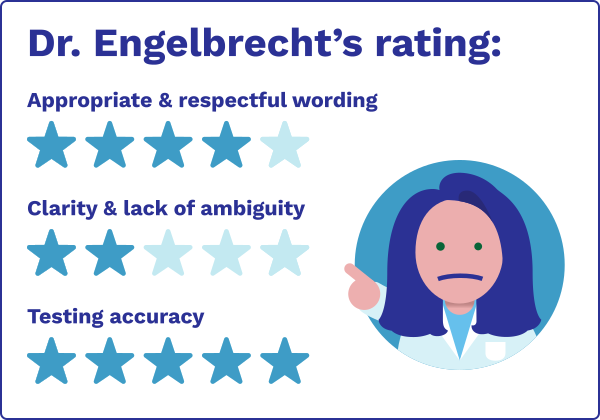
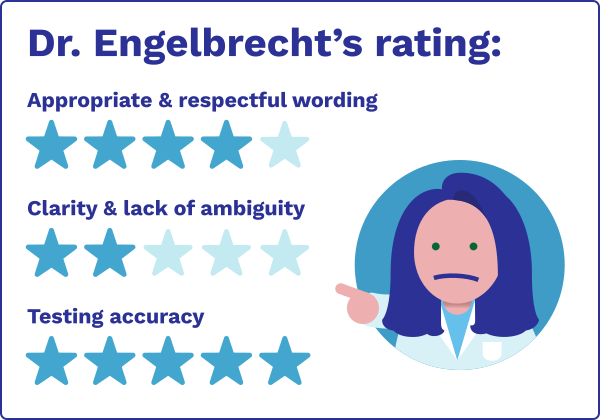
Despite the statements being pretty straightforward though, I did notice a few biases. For instance, item #5 states “I can’t tell whether I’m happy, excited, or amused.” While I think listing examples is a good idea to clarify what is being asked, I pro chose mildly agree, because in many contexts happiness and excitement either seem to be the same to me, or they tend to show up as a pair which makes it difficult to distinguish between them. If the statement had listed different emotions as examples, I may have chosen disagree. Whereas the negative emotions that are listed in #2 seem way more distinct to me.
Also, item #7 states, “When I’m feeling bad, I can’t talk about those feelings in much depth or detail.” I feel this is quite an ambiguous statement. What is almost certainly meant is how much difficulty one experiences when reporting on negative emotions. However, it’s easy enough to interpet the sentence to mean you can’t talk about it for emotional reasons; you might feel too overwhelmed in the moment and regulate yourself before you can discuss it, or you feel bad because of a triggering situation that prevents you from talking about today. I think it should have been made clearer that the item deals withthe inability to identify and report, as opposed to situational reasons for not being able to talk
Eva’s scores:
Negative-Difficulty identifying feelings (N-DIF)
- Female scoring ranges: 7 or less (low), 8–20 (moderate), 21+ (high)
- My score: 9 (average)
Positive-Difficulty identifying feelings (P-DIF)
- Female scoring ranges: 5 or less (low), 6–17 (average), 18+ (high)
- My score: 9 (average)
Negative-Difficulty describing feelings (N-DDF)
- Female scoring ranges: 9 or less (low), 10–22 (average), 23+ (high)
- My score: 19 (high)
Positive-Difficulty describing feelings (P-DDF)
- Female scoring ranges: 6 or less (low), 7–18 (average), 19+ (high)
- My score: 12 (average)
General-Externally orientated thinking (G-EOT)
- Female scoring ranges: 17 or less (low), 18–38 (average), 39+ (high)
- My score: 34 (average)
General-Difficulty identifying feelings (G-DIF)
- Female scoring ranges: 14 or less (low), 15–36 (average), 37+ (high)
- My score: 18 (average)
General-Difficulty describing feelings (G-DDF)
- Female scoring ranges: 16 or less (low), 17–40 (average), 41+ (high)
- My score: 28 (average)
Negative-Difficulty appraising feelings (N-DAF)
- Female scoring ranges: 17 or less (low), 18–43 (average), 43+ (high)
- My score: 28 (average)
Positive-Difficulty appraising feelings (P-DAF)
- Female scoring ranges: 12 or less (low), 13–35 (average), 36+ (high)
- My score: 21 (average)
General-Difficulty appraising feelings (G-DAF)
- Female scoring ranges: 31 or less (low), 32–76 (average), 77+ (high)
- My score: 49 (average)
Total scale score
- Female scoring ranges: 50 or less (low), 50–114 (average), 114+ (high)
- My score: 83 (average)
Permission to Use the PAQ
A key goal of developing the PAQ was to enhance the accessibility of robust alexithymia assessments. As such, the PAQ is freely available for use. As the copyright holders (© Preece et al. 2018), we grant you permission to use the PAQ an unlimited number of times. You can use and reproduce the PAQ in paper form, or can administer the PAQ to respondents online (i.e., you do not need to contact us to obtain permission to use the PAQ).
PAQ
Please read each statement below and choose the answer that best fits your experiences.




Comments
Let us know what you think!